
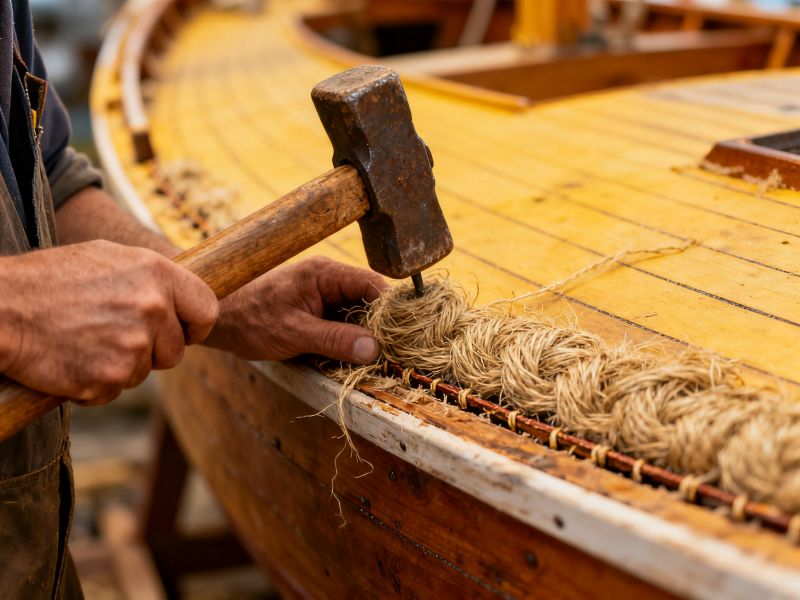
Watch a caulker work an old carvel-planked hull and you learn fast that the job is not about filling gaps. It is about controlled compression. Oakum — tarred hemp fibre, or cotton on finer work — gets driven into the seam between planks with a caulking iron and a mallet, blow after blow, until the strands pack tight enough to swell against water but not so tight that the plank edges crush. Two millimetres too deep and the hull weeps. Two millimetres too hard and you have split a plank that survived forty winters. A good caulker reads the wood the way a physiotherapist reads a shoulder: grain。moisture content, the small give under the iron. On a twelve-metre cutter there is something like four hundred metres of seam, and every metre of it has to be judged by feel, because no gauge on earth tells you when to stop.Caulking is one of the oldest specialisms in boatbuilding, and for most of that history it was a separate gang from the joiners and riggers. Naval yard books list caulkers by name and by wage, which tells you the trade had standing. The word then split in two directions. A marine caulker worked pitch。oakum, and later bitumen and lead;a building caulker worked window frames, thresholds, the joint around a bath. Same title, entirely different hands. In nineteenth-century logging camps the word drifted into slang for a heavy drinker, presumably because the job meant crouching in cold, wet, unventilated spaces for weeks on end. That reputation is undeserved now, though the working conditions have not improved as much as the marketing suggests.
Modern sealants made the caulker's kit lighter and the decisions harder. A polyurethane cartridge and a skeleton gun will bridge a joint in seconds, which means the skill migrated from application to selection. Which joint is designed to move, which one has to stay rigid, which substrate needs a primer。which one will reject anything you put on it — that is the actual work. Failed sealant jobs almost never fail in the middle of the bead. They fail at the interface, where somebody sealed a damp substrate, or sealed a joint that should have been left open to drain, or buried a weep hole behind a neat grey line. I have seen a cockpit drain quietly blocked by a well-intentioned caulker with a fresh tube and no diagram, and the resulting bill ran to four figures.
Hiring one is its own exercise in reading signals. Ask what they use on teak。and a real caulker will ask you back whether the teak is oily, how old it is, and whether the seam is a butt joint or a rebate. Ask for a price per metre and you will get a range, not a number, because the quote depends on seam depth and how much of the old material has to come out — and pulling old caulk is the slow, ugly half of the job that nobody photographs. Anyone who quotes a flat rate over the phone without seeing the boat is selling a bead of silicone and a shrug.The craft survives because water is patient. A caulker's work is judged not on the day it is finished, when everything looks immaculate, but two seasons later。when the seams have cycled through heat, frost, and a hundred slam landings and the bilge is still dry. That is a strange sort of craftsmanship — invisible when correct, obvious when not, and rarely credited in the yard's final invoice.